Hi darlings! I’m glad to hear that you learned a thing or two from the Allure article. Now get ready to learn even more about how to spot potentially dangerous moles. Alex from I Eat Asphalt put together this amazing post to share with you all. Alex actually works at a Dermatology practice, so this lady really knows what she’s talking about! Enjoy =)
Holy Mole-y?
Gracie has provided a ton of great info about the dangers of tanning and sun exposure, but I will be the first one to admit that I did the tanning regime while in high school and college. I’m currently working for a Dermatologist, and let’s just say I’ve been scared into lathering myself with SPF 30 every day… even when working in an office with fluorescent lights. If you are guilty of one too many sunburns, start checking your skin periodically. Changing or irregular moles can be serious and should be evaluated by a dermatologist. Identifying a potentially cancerous mole is as easy as A-B-C-D-E.
A = Asymmetry. If you draw a line through the mole, are the two sides equal?
B = Border. Are the borders uneven or scalloped?
C = Color. Is the mole one solid color, or is it several different shades? Is it brown or has it changed to red?
D = Diameter. Cancerous moles are typically larger than the size of a pencil eraser. Does this mole look larger than other moles?
E = Evolving. Has this mole changed in any way (color, size) or started to bleed or itch?

Okay, so maybe your mole is just a little funny looking but isn’t as bad as the descriptions above. Sun exposure can cause several different types of pre-cancerous and cancerous skin lesions.
A general irregular mole is a Dysplastic Nevus, which is an unusual benign mole that may resemble melanoma. People who have a DN are at an increased risk of developing a skin cancer later in life.

A large, crusty skin lesion is most often an Actinic Keratosis, which develop from chronic sun exposure. AKs develop when ultraviolet light from the sun damages cells in the skin, specifically affecting the keratinocytes which give skin its texture. AKs are the most common pre-cancerous lesion.

The most common type of skin cancer is Basal Cell Carcinoma occurring the basal cells, which line the deepest layer of the epidermis. Nearly all reported basal cells occur on areas of the body that were chronically exposed to the sun, such at the face, neck, back and shoulders. Basal cells often do not resemble other irregular moles and have a separate class of characteristics.

Squamous Cell Carcinoma is the second most common type of skin cancer. SCC arises in the squamous cells that make up most of the skin’s epidermis. Squamous cell carcinomas may occur on all areas of the body, but is most commonly seen in areas with high sun exposure. Here’s a startling fact: Frequent use of tanning beds multiplies the risk of developing a squamous cell by 2.5 times. Squamous cell carcinomas typically appear as a thick, rough, scaly patch that can bleed if irritated.
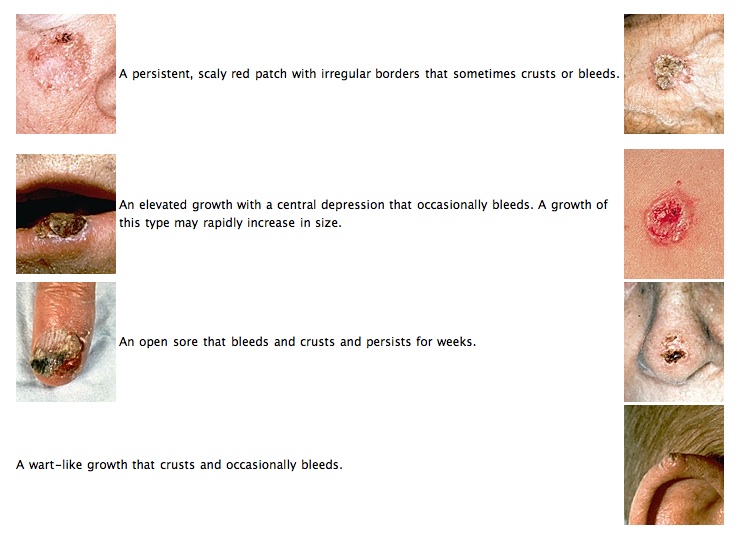 So let’s say that your dermatologist has identified a suspicious lesion and confirmed the diagnosis with a biopsy. What are your treatment options? Most pre-cancerous and cancerous lesions are removed through a local surgery. These procedures can be completed in the doctor’s office without anesthesia, and often have both short healing times and minimal complications. The only major side effect is scaring from stitches. Several other options exist to treat lesions, which are evaluated based upon the patients past medical history, medications and age.
The only way to prevent these lesions is protective skin measures. This means applying an SPF of at least 15 every day. This will not only help prevent a nasty growth, but will also help to keep you wrinkle free. And that is a beautiful thing my friends.
Sources
Skin Cancer Foundation: http://www.skincancer.org/
American Academy of Dermatology: http://www.aad.org/public/
A HUGE thanks goes out to Alex for this wonderful post. You’re the best, girl! 
- Have you ever experienced a strange-looking mole? Did you get it checked out by a doctor?


Interesting post! I live in the sun, and spent the entire winter getting my skin back to where it needs to be. I have a serious collection of SPF now.
xo
WoW! This is crazy good info girl! Sometimes we just think, “yeah I need to protect against skin cancer,” but you’re showing us WHY we need to do so. Thanks for the great info!
amazing post!! so glad you did this…I get so scared sometimes of the sun! I used to tan in college WAY too often, but never again and havent in about 3 years!
I love how easy this was to follow. Thank you for the awesome facts. Even though I’m only 19 I check my skin for moles all the time!
Hey! I am so excited about these past two posts! I have actually started a “sunscreen challenge” and I would LovE LOVE LOVE for you to help me get more participators! Basically I am challenging other bloggers to talk about how they are protecting their skin for 30 days. Just a quick blurb is all I ask. I am hoping it will grow and spread the word about the dangers of skin cancer! This is the post: http://thehealthyapron.com/2010/05/13/sunscreen-in-foods-how-to-keep-your-skin-protected/
I will be honest, I don’t have a lot of followers so it would be great to get more popular bloggers on board to help me spread the word! Help me make “pasty” the new tan!! Hope you’ll consider it! Thanks girl!
Dana says
I had a weird mole once and got it removed. I use to tan in tanning beds a bunch but no more for me!
Dana
http://happinessiswithin.wordpress.com/
ahh i remember learning all about this in my many many science courses in college.
love that you lay down the facts for all to read and learn about. SUNSCREEN!
Claire Richardson says
Sunblocks can also reduce the incidence of skin cancer by preventing UV to harm your skin.:`’
Millie Wood says
skin cancer is rarer than colon cancer but just as deadly,*;
Plastic Pond says
well, skin cancer incidence would be increasing because of the hole on the ozone layer “;”
Nicci says
crap… i’m like 90% sure i have a DN on my boob… this is gunna hurt…
Cancer love compatibility says
Cancer of the skin is actually clinically determined more often than all the other types of cancer blended. Within 2006, over 62,thousand individuals in the united states found they’d this particular melanoma …cancer